Sustainable Paving Stones sits between two of the largest opportunities in modern construction: a near-limitless, low-cost supply of recycled asphalt, and the demand to resurface the roads, yards, and lots across the developed world. A single material connects them — and we cannot exist without it.
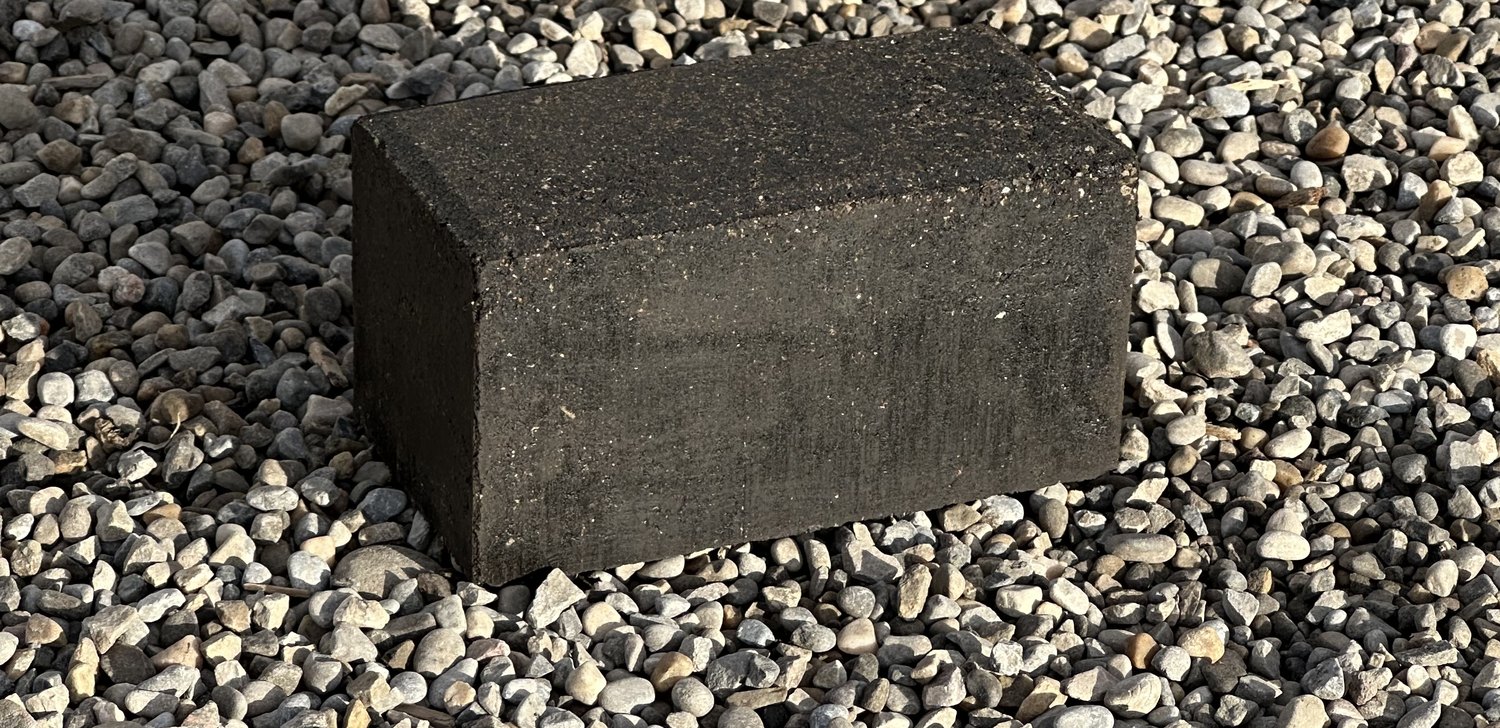
Finished stone — manufactured from reclaimed asphalt pavement with recycled asphalt shingle.
We began by setting out to recycle asphalt shingle. We learned that we could turn it into a durable paving stone — but only in combination with reclaimed asphalt pavement. Then, through our own testing this past winter, we found the result that reshaped the opportunity: the paving stone performs essentially the same whether or not shingle is part of the mix.
That makes reclaimed asphalt pavement — RAP — the one input we cannot do without, and it is generated wherever roads are built, maintained, milled, or removed. It is among the most reclaimed materials in construction: produced continuously, available at low cost, and present in virtually every developed region on earth. Depending on RAP is not a constraint — it is the reason our addressable feedstock is effectively global, and effectively perpetual.
Recycled asphalt shingle remains a valuable secondary input wherever it is available. It lowers our material cost, and by diverting roofing waste from landfill it helps solve a genuine societal problem: the U.S. EPA estimates 11–13 million tons of asphalt shingles are torn off American roofs each year, and adding Canada at roughly 10% more puts the North American total near 12–14 million tons annually. But because shingle improves the product rather than enabling it, we are not confined to the regions where shingle recycling exists. Where shingle is available we use it; where it is not, reclaimed asphalt pavement alone still yields a fully sound paving stone.
If the feedstock is global, so is the market it serves. Conventional asphalt covers the roads, yards, and lots of the developed world — and every one of those surfaces is a candidate for a more durable, lower-lifecycle-cost replacement. Our view is that adoption proceeds in stages, beginning where the case is easiest to prove and the performance bar is most clearly met.
Where adoption begins
Where it leads — our long-term thesis
The lower rungs are not speculative. Segmental pavement has carried heavy urban traffic for decades — and in some installations, for more than a century. The later rungs are stated as our thesis for where the technology leads, not as a present claim. The supporting evidence is gathered on the Proof pages.
The upper rungs are an engineering reality, not a hope. At 100 mm thickness, our paving stones are rated across every road class — local, commercial, minor collector, major collector, and arterial.
Segmental pavers are engineered to recognized structural standards measured in equivalent single-axle loads (ESALs) — the same metric highway engineers use to rate any pavement — up to roughly 9,000,000 ESALs over their service life. The engineering for the upper rungs already exists; adoption, not capability, is the variable.
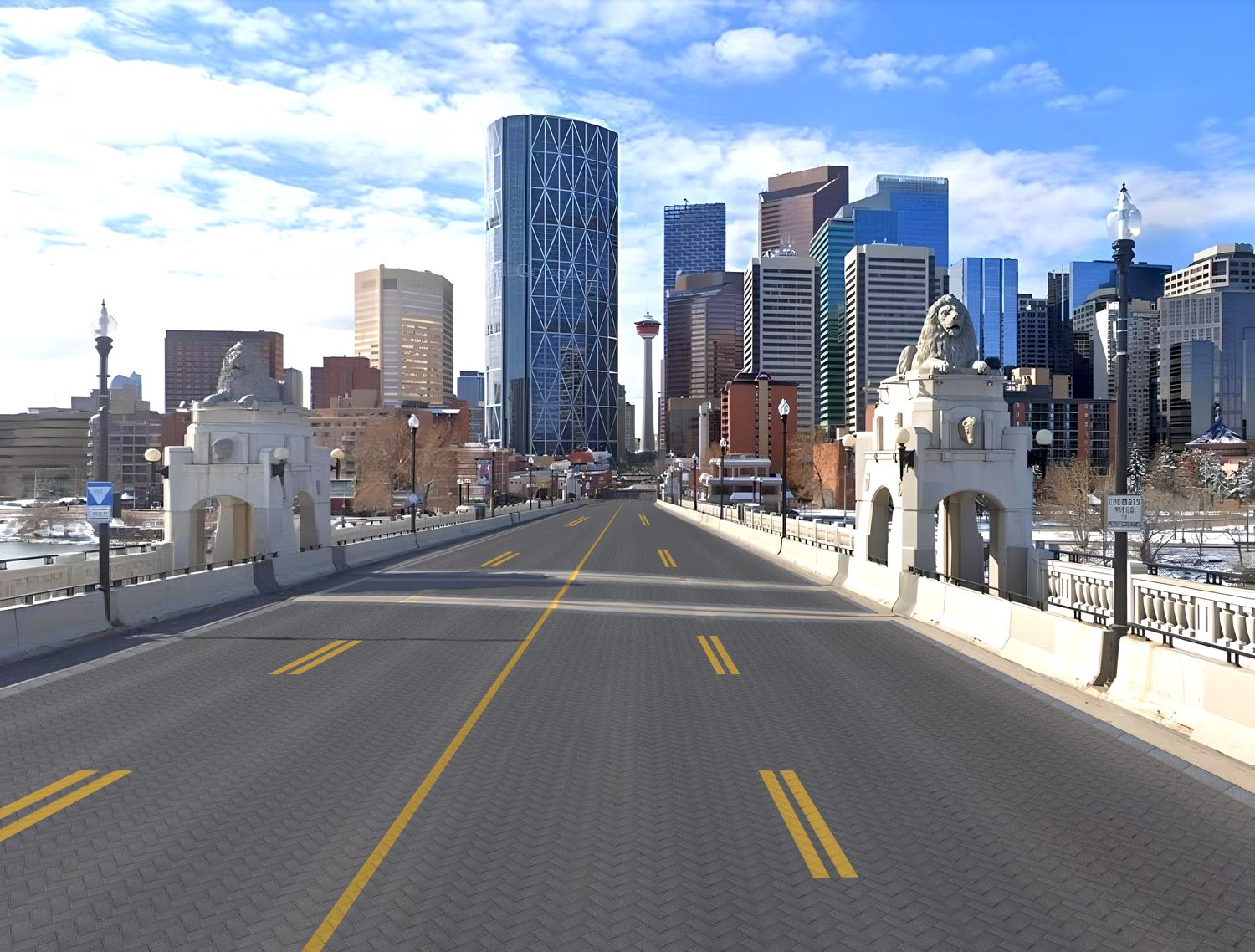
Visualization: a Calgary street resurfaced in our paving stones. See the full before-and-after gallery.
Each rung is larger than the one beneath it. The earliest applications are the easiest to win on performance and economics; each success makes the next rung credible to the buyers above it.
The destination is not a niche surface for premium driveways. It is the gradual replacement of conventional pavement with a recycled, repairable, longer-lived alternative — at the scale of a road network.
Conventional asphalt is inexpensive to lay and expensive to own. It is resurfaced on a recurring cycle, patched continuously, and torn out entirely when it fails. Segmental paving inverts that equation: a more durable surface that is repairable in place — lifted and reinstated rather than repaved — and engineered to stay in service through many cycles of conventional-asphalt resurfacing.
For the buyers who matter most to large-scale adoption — municipalities, road authorities, and industrial operators — the deciding figure is rarely the price per square metre. It is the total cost of ownership over the life of the surface. That is the ground on which recycled asphalt paving stones decisively outperform the alternatives.
Evidence — North Bay, Ontario · Main Street, interlocking pavers since 1983
The North Bay surface used concrete pavers; its independently documented lifecycle data is directly applicable to segmental asphalt paving stones. Read the full North Bay case study, including the 1991, 2003, and 2015 engineering reports.
Hot-mix asphalt arrives hot and has to be laid inside a narrow temperature window. Fall outside it and the load is rejected — so the crew works against the clock, with the cooling material dictating the schedule. Paving that out takes several large, expensive machines and a sizeable crew whose real job is to beat the temperature before it drops.
Our paving stones remove the clock entirely. They are delivered cold and stable; a load can arrive two weeks or a month ahead and be installed at a measured pace, in stages, whenever conditions and labour allow. A typical crew is about five people working two or three small machines with relatively inexpensive attachments — not a fleet of heavy equipment racing a cooling load.
For an owner, that turns a high-pressure, weather- and logistics-bound operation into a predictable one: simpler equipment, a smaller crew, no rejected loads, and material delivery decoupled from installation day.
| Aspect | BlackTop Enduro™ | Road Asphalt | Concrete Paver |
|---|---|---|---|
| Expected lifespan | ★★★★★ | ★★★★★ | ★★★★★ |
| Compressive strength | ★★★★★ | ★★★★★ | ★★★★★ |
| Tensile strength | ★★★★★ | ★★★★★ | ★★★★★ |
| Water absorption | ★★★★★ | ★★★★★ | ★★★★★ |
| Freeze–thaw durability | ★★★★★ | ★★★★★ | ★★★★★ |
| Recycled content | ★★★★★ | ★★★★★ | ★★★★★ |
| Low carbon content | ★★★★★ | ★★★★★ | ★★★★★ |
| Colour selection | ★★★★★ | ★★★★★ | ★★★★★ |
| Finish selection | ★★★★★ | ★★★★★ | ★★★★★ |
| Equipment requirements | ★★★★★ | ★★★★★ | ★★★★★ |
| Utility-access friendly | ★★★★★ | ★★★★★ | ★★★★★ |
| Ease of repair | ★★★★★ | ★★★★★ | ★★★★★ |
| Affordability | ★★★★★ | ★★★★★ | ★★★★★ |
Five-point scale (5 = strongest). Ratings are our comparative assessment across typical roadway and yard applications; road asphalt and concrete paver are shown as baselines.
Where the ratings above come from — surface by surface.
| Aspect | Recycled Asphalt Paving StoneBlackTop Enduro™ | Road Asphalt | Concrete Paver |
|---|---|---|---|
| Recycled content | At least 99.5% reclaimed material — reclaimed asphalt pavement with recycled asphalt shingle. A trace of additive and, at times, a small amount of new asphalt cement totals under 0.5%, so the mix rounds to effectively 100% recycled. | Predominantly virgin binder and aggregate. Reclaimed asphalt is sometimes added, but most mixes remain largely virgin. | Predominantly virgin cement and aggregate, with little to no recycled content. |
| Greenhouse-gas footprint | Low. No virgin bitumen or cement is manufactured, the process avoids the energy of hot-mix production, and roofing and paving waste is diverted from landfill. | Higher. Depends on virgin bitumen and on energy-intensive hot-mix production at temperature. | Higher. Portland cement is among the most carbon-intensive construction materials, releasing CO₂ through both fuel use and calcination. |
| Structural rating | Segmental units engineered to recognized structural standards; at 100 mm, rated across road classes to roughly 9,000,000 ESALs. | A continuous mat that ruts, ravels, and cracks as it ages, losing structural capacity over its service life. | Segmental units engineered to recognized structural standards; at 100 mm, rated across road classes to roughly 9,000,000 ESALs. |
| Freeze–thaw behaviour | Excellent. Near-zero voids and very low water absorption leave little water to freeze, so the surface resists frost damage. | Water enters at cracks and joints; freeze–thaw cycling widens those cracks and drives potholing. | Roughly 5% voids let water migrate into the unit; repeated freezing expands that water and deteriorates the paver over time. |
| Repair & utility access | Individual units lift out and reinstate in place — no full repave — and that same access makes reaching buried utilities simple. | Saw-cutting, patching, and mill-and-overlay; patched joints tend to become recurring failure points. | Individual units lift out and reinstate in place — no full repave — and that same access makes reaching buried utilities simple. |
| End of life | Units are lifted and reinstated, or reprocessed back into new stone — the material stays in service. | Milled and recycled as reclaimed asphalt pavement — in fact the same feedstock our stones are made from. | Freeze–thaw damage leaves units fit only to be downcycled — crushed into rubble for fill rather than reused as pavers. |
Taken together, the three arguments compound. A feedstock that is cheap, recurring, and available almost everywhere gives us a durable cost position. A market that spans every paved surface gives it a runway measured in decades. And an economic case grounded in lifecycle cost gives buyers a reason to switch that does not depend on subsidy or sentiment.
A century of durability and forty years of lifecycle-cost data.
View the proof →Real streets, resurfaced — before-and-after visualizations.
Open the gallery →The paving stone now entering the market, under the BlackTop Enduro™ brand.
Visit BlackTop Enduro™ →