
Three independent lines of evidence stand behind recycled asphalt paving stones: a century of field durability, four decades of documented lifecycle cost, and recognized sustainability standards.
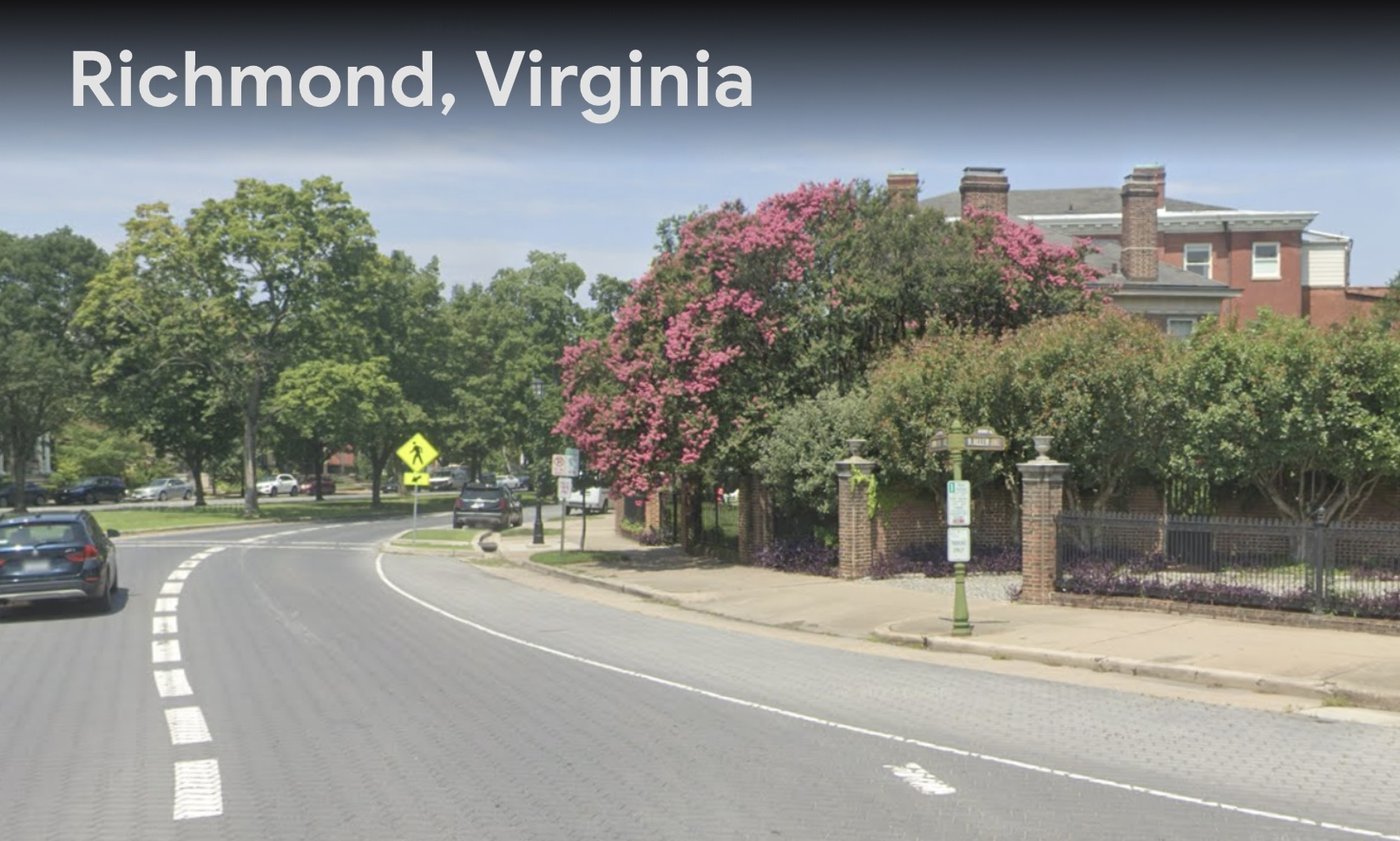
Asphaltic pavement blocks in service for over a century — Richmond, Virginia, and Savannah, Georgia.
In Richmond, Virginia, and Savannah, Georgia, asphaltic pavement blocks laid more than a hundred years ago remain in service today. They have carried over a century of heavy urban traffic, endured extreme weather and continuous pedestrian use, and they continue to perform.
This is the most demanding test any paving material can face: not a laboratory, but a century of real streets. It is also the clearest available answer to the first question every infrastructure buyer asks — how long will it last. Our paving stones are built on the same segmental, asphaltic principle those century-old installations have already proven.
In 1983, the city of North Bay, Ontario, made an unusual choice. Rather than repave its Main Street in asphalt, it laid 150,000 square feet of interlocking pavers. Four decades later, that decision stands as one of the best-documented lifecycle-cost comparisons in North American municipal paving.
It held. At twelve years, the surface had required zero maintenance. At sixteen, its condition was rated very good to excellent. At thirty-two years, it was still performing. It remained in service until 2025 — forty-two years after it was laid.
A lifecycle-cost analysis at the sixteen-year mark found maintenance roughly $76,000 lower per lane-kilometre than an equivalent asphalt street, with rehabilitation needed less often across the life of the surface. The advantage is not only at installation — it accumulates over the life of the surface. That is the number that matters to the municipalities, road authorities, and industrial operators who buy on total cost, not sticker price.
“Main Street has always been the centerpiece of the city, and the pavers set it off.”
Adam Lacombe · Senior Capital Program Engineer, City of North Bay
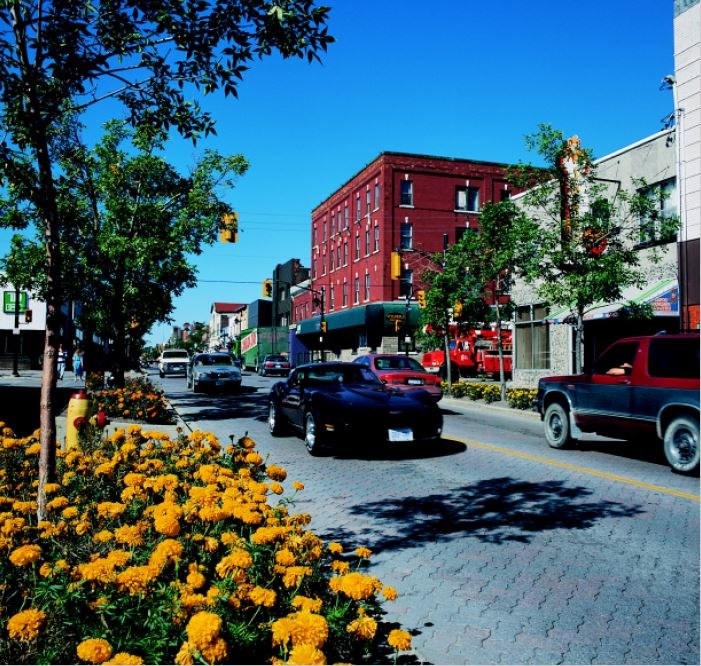
Main Street, North Bay.
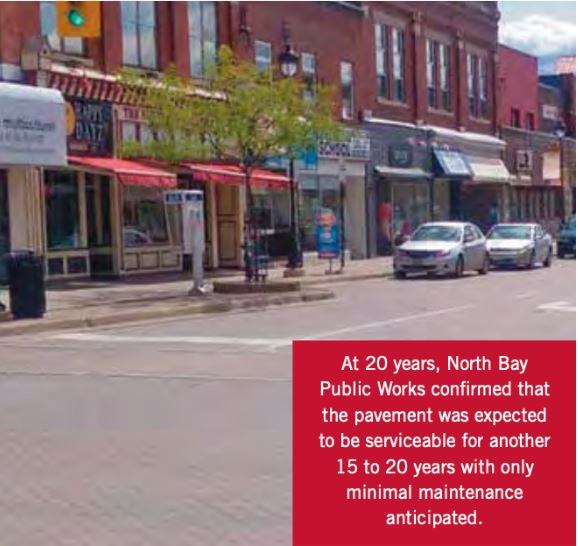
The same surface, twenty years on.
The North Bay surface used concrete pavers rather than our asphalt paving stones. Its independently documented performance and cost data are directly applicable to segmental asphalt paving.
Sustainability is no longer a preference in public and institutional construction — increasingly, it is a procurement requirement. As a recycled-content material that lowers embodied carbon, our paving stones contribute toward several recognized LEED® credit categories — a focus that weighs heavily in the current LEED v5 standard, where roughly half of all credits are tied to decarbonization. That matters precisely because the buyers most able to adopt paving at scale are the ones bound by these standards.
Made from recycled content, contributing toward materials and resources credits.
A recycled-content surface that displaces virgin asphalt cement, helping lower a project’s embodied carbon under LEED v5’s life-cycle assessment and embodied-carbon credits.
Locally produced, supporting regional-materials credit requirements.
For a road authority or institutional developer, that turns sustainability from a cost into a credit — reinforcing the economic case rather than competing with it.
Individually, each line of evidence answers one objection. Together, they describe a paving material that lasts longer, costs less to own, and satisfies the standards the market is moving toward. That convergence is the foundation of our case.